
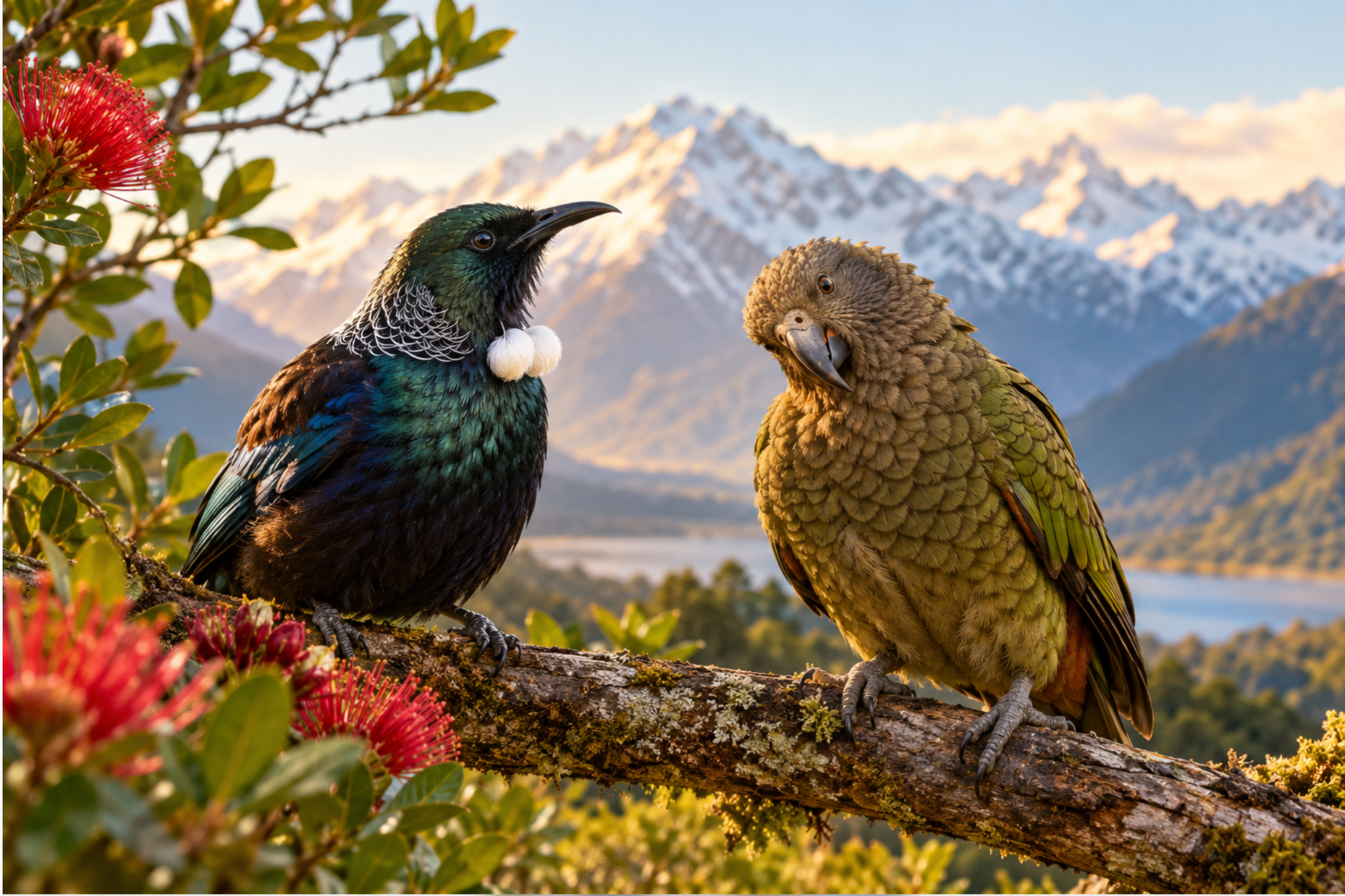
Lessons in connection, contribution and collective performance from two remarkable New Zealand birds.
One of the things I love most about New Zealand is the sound of the Tūī. When we lived in NZ, there was a Tūī that used to visit the tree outside our bedroom window every morning. I loved listening to it sing, and if you've ever heard a Tūī, you'll know they have quite the collection of sounds! I always thought it was such a beautiful way to start the day.
Over time, I looked forward to my little morning visitor, and on the very last morning before we moved back to Australia, there it was again, singing away as usual. Then it flew off, almost as though it had popped by to say goodbye. I know that's probably giving the bird a little too much credit, but I still like to think that's what happened.
To this day, whenever I'm back in New Zealand, I listen out for the Tūī. There's something about hearing that familiar song that instantly makes me smile. It reminds me of our years living there, the wonderful people who became part of our lives and a place that will always feel a little like home.
I've always felt a connection to the Tūī, although it wasn't until a recent road trip through New Zealand with my Practice Manager, Heidi, that I started thinking about what these remarkable birds might teach us about people.
On the last day of our trip, we were driving through Arthur's Pass when we came across some Kea. They're incredibly intelligent, curious about absolutely everything and well known for their playful nature and tendency to get into mischief, especially when there's something new to investigate. Some might even say they're cheekily rebellious!
After seeing both birds during our travels, we started reading about their characteristics, and it didn't take long before we recognised ourselves.
There was me, the Tūī, with my distinctive voice and love of a good conversation, while Heidi was every bit the Kea, curious about everything, exploring possibilities and wanting to understand how things work.
I've always been someone who thinks out loud. I love a good conversation, hearing how other people see things and getting excited about what might be possible. Often, I'll start with an idea, and by the time we've talked it through together, it's become something far more interesting than what I first imagined. Heidi has this wonderful curiosity that means she's always asking questions and exploring different angles. She has a real knack for understanding what I'm imagining and helping give those ideas form and function. She's also an incredible listener who takes a genuine interest in people and what makes them tick.
Our different ways of thinking are part of what makes working together fun and exciting. My ideas often spark Heidi's curiosity, her questions get me thinking differently, and between us we find ways to bring things to life. Two very different birds, two very different personalities, and a rather funny reminder of how well our differences can work together.
It got me thinking about how much time we spend understanding our individual strengths in business, and how much attention we give to what those strengths could create together.
Knowing our strengths is only the beginning
Throughout my career, I've used all sorts of personality profiles, behavioural assessments and leadership tools to help people understand themselves and each other. I've always found human behaviour fascinating, especially how two people can look at exactly the same situation and see something completely different.
These tools can be incredibly useful. They help us recognise our own tendencies and appreciate the strengths other people bring. I've seen some wonderful conversations come out of them, including a few moments when people finally understand why a colleague approaches things the way they do!
What interests me, though, is what happens afterwards.
I've seen teams walk away with a much better understanding of each other, only to go straight back to working exactly as they did before. Everyone knows who the big-picture thinker is, who loves the detail, who asks the difficult questions and who naturally brings people together. It's useful knowledge, although knowing these things doesn't automatically change how people work together.
Imagine if the person with the big idea actively sought out the colleague who loves getting into the detail, or if the person who spots potential problems was welcomed into the conversation early enough to help shape the decision. What if people started looking for each other's strengths because they genuinely valued what those different perspectives could add?
I've worked with teams full of talented, capable people who were achieving individually, while the business was still missing out on what they could accomplish together. The difference comes when people start sharing their thinking, challenging each other, offering help and taking a genuine interest in each other's success.
What happens when people genuinely work together
There's something wonderful about being part of a team where people genuinely want each other to succeed. You can feel it in the conversations, the willingness to help and the way people share ideas without worrying about who gets the credit.
I've experienced this throughout my career, and some of my favourite memories come from working alongside a national sales team in New Zealand.
Our business development managers worked closely with their team leaders across the country. They knew their people, understood what was happening in their regions and often saw opportunities or challenges that weren't immediately obvious from a national perspective.
Imagine how much of that knowledge and experience we would have missed if every decision had to come through one person.
We had a clear vision of where we wanted to go, and everyone understood the part they played in getting us there. The real opportunity was creating an environment where people felt confident enough to share what they knew, challenge each other's thinking and contribute to decisions that would shape our direction.
Our meetings were full of conversation. We made time to reflect on what was working, talk openly about what wasn't and explore what we could do differently. Sometimes smaller groups would work through an opportunity or challenge before sharing their thinking with everyone else.
There was plenty of healthy debate, a few uncomfortable conversations and no shortage of opinions! We didn't always agree, but we respected what each person brought and understood that questioning an idea could make it stronger.
What I loved watching was how naturally people began to turn towards each other.
Someone facing a challenge in one region would reach out to a colleague who had experienced something similar. An idea shared in one meeting might inspire a completely different approach elsewhere. People celebrated each other's wins, offered support when things weren't going to plan and became increasingly invested in what the whole team could achieve.
Of course, none of this meant leadership disappeared. Clear direction, expectations and accountability still mattered enormously. People needed to understand where we were heading and why, while having the trust and freedom to use their own judgement and work with each other to find the best way forward.
There's research that helps explain why this matters. A 2024 meta-analysis examining team reflexivity, where teams collectively reflect on their goals, strategies and ways of working, found a positive relationship with team performance. [1]
We didn't have a name for it at the time. We simply made room for people to think together, learn from one another and keep finding ways to improve.
Over time, that way of working became part of how the team operated. People weren't waiting to be told what to do at every turn. They understood the direction, trusted each other and took responsibility for moving things forward together.
Over those years, we achieved 158% growth in just two years. An extraordinary result, although what I remember most is the people behind it, the confidence they developed and the pride they took in each other's success.
When leaders create an environment where people understand where they're going, feel trusted to contribute and recognise the value in each other's strengths, ideas travel further, challenges become shared conversations and responsibility spreads across the team.
The opportunity sitting between people
Thinking back to the Tūī and Kea, each has its own place in New Zealand's natural world, contributing in different ways. Now, I'm not suggesting they're sitting together developing a shared strategic plan, although that would be fun! It makes me think about how businesses operate and how much depends on what happens between people.
A decision made by a leadership team affects the people responsible for delivering it, just as a promise made to a customer creates expectations for someone else in the business. Something learned in one department could save another hours of work or uncover an opportunity they hadn't considered. Our work is connected in so many ways, yet I've seen businesses full of talented, hardworking people who genuinely care about what they do still struggle to achieve what they're capable of together.
Often, people are so busy meeting deadlines, solving problems and looking after their own responsibilities that opportunities to share ideas, learn from each other or make everyone's work easier get missed. When performance comes under pressure, it's understandable that leaders focus on productivity and individual accountability, but I wonder how often we overlook the potential that's already sitting within the team.
Imagine what could change if people better understood how their work connected with others and felt comfortable asking questions, sharing what they were learning and speaking up when they saw a better way. How much more could they achieve together?
A 2024 study published in PLOS ONE found a positive relationship between psychological safety, communication and innovation within teams. [2] When people feel comfortable asking questions, sharing ideas and challenging each other's thinking, they have more opportunities to draw on the knowledge and experience around them.
Are we developing our technology faster than our teams?
I've been thinking a lot this week about how much time, money and attention businesses are investing in AI. Everywhere I turn, leaders are talking about new tools, automation, training and the extraordinary possibilities AI is creating.
I'm fascinated by it myself and can see enormous potential to change the way we work. With so much attention going into developing our technology, though, I keep wondering whether we're investing as intentionally in developing how our people work together.
Interestingly, McKinsey reported in October 2026 that while 70% of respondents felt personally ready for AI, only 27% of leaders believed their organisations were ready for the changes ahead. [3]
We can give people extraordinary technology, help them work faster and put more information at their fingertips. Imagine how much more valuable those capabilities become when people also know how to bring their different strengths together, challenge each other's thinking and take shared responsibility for what they're trying to achieve.
I believe the leaders who recognise this early and invest in developing their people alongside their technology will be better placed to navigate the changes ahead. The more capable our technology becomes, the greater the opportunity to think about how we're developing the people using it, and the relationships that allow them to achieve more together.
There's an enormous opportunity here for businesses willing to give both the attention they deserve.
Different voices, extraordinary possibilities
The more I work with teams and business owners, the more I see how much of our success depends on what happens between people. The conversations we have, the trust we build, the ideas we share and the willingness to contribute to something bigger than ourselves.
When people take the time to connect, they begin to understand each other and appreciate the strengths they bring. Through communication, they share ideas, challenge their thinking and find common ground. When everyone feels they have something valuable to contribute, that understanding begins to turn into action.
I still smile when I think about driving through Arthur's Pass and recognising ourselves in two rather different New Zealand birds. Heidi will always have her curious, adventurous Kea, and I'll always have my Tūī, with its unmistakable song and the memories it brings of a place I love.
Of course, these two birds aren't out there working towards a common goal. What I love is how their differences helped us recognise something about our own partnership, and how much more we can create when we bring our different perspectives and strengths together.
It's something I've seen throughout my working life. Having different strengths alone doesn't guarantee better results. What matters is how we recognise and value those strengths, create opportunities for people to contribute and build the trust that allows everyone to work towards something they believe in.
There's always value in helping people become better at what they do. Imagine what could happen if we gave just as much attention to helping them become better at what they can do together.
[1] Team reflection and performance
Leblanc, P.-M., Harvey, J.-F., & Rousseau, V. (2024). A meta-analysis of team reflexivity: Antecedents, outcomes, and boundary conditions. Human Resource Management Review, 34(4), 101042.
[2] Psychological safety, communication and innovation
Jin, H., & Peng, Y. (2024). The impact of team psychological safety on employee innovative performance: A study with communication behavior as a mediator variable. PLOS ONE, 19(10), e0306629.
[3] AI readiness and organisational change
McKinsey & Company. (2026). Closing the AI readiness gap. https://www.mckinsey.com/capabilities/people-and-organization/our-insights/from-adoption-to-impact-three-horizons-of-ai-transformation